Industrial safety guide for risk control, compliance and safer operations
Industrial safety is the discipline of preventing injuries, illnesses, equipment damage and operational disruption in workplaces such as factories, plants, warehouses, maintenance shops and processing facilities. A strong program does more than issue rules or hand out personal protective equipment. It identifies hazards before work starts, ranks risk, selects controls through a clear hierarchy, trains people for the tasks they actually perform and checks whether those controls continue to work. Recent U.S. data show why this matters: the Bureau of Labor Statistics reported 5,070 fatal work injuries in 2024 and 2.5 million nonfatal injury and illness cases in private industry. For industrial leaders, the practical goal is not paperwork for its own sake. It is a system that makes safe work the normal way work is planned, supervised and carried out.
What industrial safety means in modern operations
Industrial safety covers the policies, engineering controls, procedures, training and monitoring used to protect workers and assets in industrial environments. It applies to routine production, maintenance, cleaning, contractor work, emergency response and nonroutine tasks such as equipment changeovers or confined space entry.
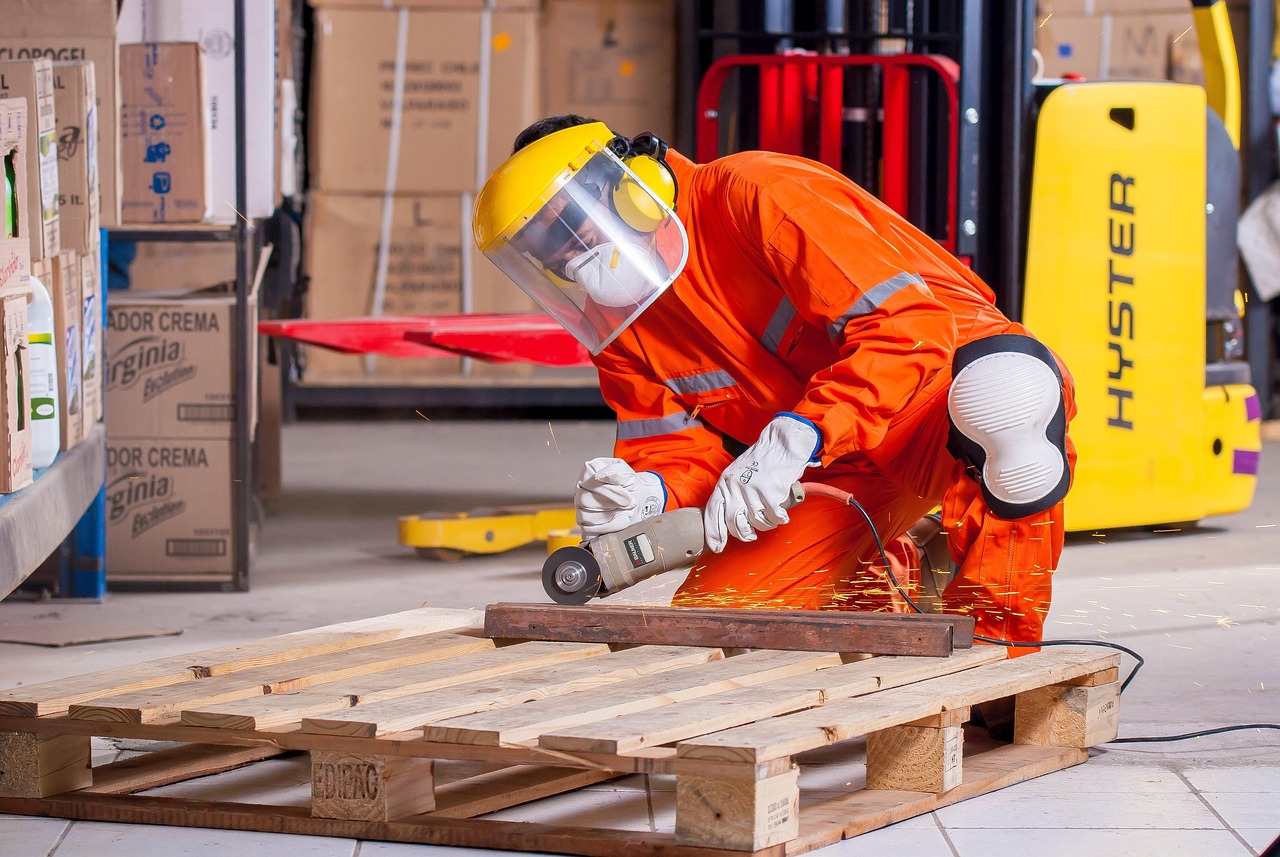
The term is often used interchangeably with occupational safety and health. In industrial settings, however, it usually places more emphasis on machinery, hazardous energy, chemicals, powered equipment, lifting operations, electrical systems, noise, heat, dust, process materials and ergonomic strain. These hazards often interact. A conveyor repair, for example, may involve stored energy, pinch points, poor lighting, time pressure, elevated work and communication gaps between operations and maintenance.
For equipment-focused industries, industrial safety should be treated as part of operational control, not as a separate compliance function. Readers can follow broader industrial equipment coverage at Qianqianshu industrial equipment.
Why industrial safety still requires attention
Workplace injury numbers change by year and by sector, but the scale remains significant. The U.S. Bureau of Labor Statistics reported that private industry employers recorded 2.5 million nonfatal workplace injuries and illnesses in 2024, down 3.1 percent from 2023. The same agency’s Census of Fatal Occupational Injuries reported 5,070 fatal work injuries in the United States in 2024, compared with 5,283 in 2023. The 2024 fatal work injury rate was 3.3 deaths per 100,000 full-time equivalent workers.
Those figures are national and are not limited to industrial equipment operations. They still show why safety programs cannot rely on good intentions alone. In industrial workplaces, one uncontrolled hazard can affect many people because machines, energy sources and production flow are interconnected. A missing guard may create an immediate contact hazard. A weak lockout process can expose maintenance workers to unexpected startup. Poor chemical labeling can create both acute exposure and emergency response problems.
OSHA’s fiscal year 2025 list of most frequently cited standards points to the same persistent risk themes. For the period from October 1, 2024, to September 30, 2025, OSHA’s top cited standards included fall protection, hazard communication, ladders, control of hazardous energy, respiratory protection, scaffolding, fall protection training, powered industrial trucks, eye and face protection and machine guarding. Not every item applies equally to every site, but the list is a useful reminder that common hazards remain common because they are built into everyday work.
The core elements of an industrial safety program
OSHA’s recommended practices describe safety and health programs around several core elements, including management leadership, worker participation, hazard identification and assessment, hazard prevention and control, education and training, program evaluation and coordination with contractors or host employers. In practical terms, those elements can be translated into a repeatable operating model.
Management leadership
Leadership begins with visible priorities and resources. If production targets are measured daily but risk controls are discussed only after an incident, workers receive a clear message about what matters most. Management leadership should include written responsibilities, budget for controls, time for inspections and training, and a process for escalating hazards that cannot be corrected immediately.
Worker participation
Workers often understand task-level hazards better than anyone else because they see the gap between written procedures and actual conditions. OSHA emphasizes worker participation because effective programs need input from the people who operate, clean, repair and inspect equipment. Participation should include a way to report hazards, near misses and unsafe conditions without retaliation. It should also include feedback. If a worker reports a damaged guard or a recurring jam, the organization should communicate what was done and what remains open.
Hazard identification and assessment
Hazard identification is not a one-time checklist. It should take place during equipment design review, installation, commissioning, production changes, maintenance planning, incident investigation and periodic inspections. Useful inputs include job hazard analyses, machine risk assessments, safety data sheets, exposure monitoring, injury logs, maintenance records, operator observations and emergency drills.
Hazard prevention and control
After hazards are identified, the next step is to decide which controls are strong enough for the risk. Controls should be prioritized by severity and likelihood. A high-energy mechanical hazard should not wait behind minor housekeeping tasks simply because it is harder to solve. Where resources are limited, a worst-first approach helps focus action on hazards that can cause severe harm.
Training and competence
Training is effective only when it is tied to the work people actually perform. A general safety presentation may explain expectations, but it cannot replace task-specific instruction for lockout, forklift operation, chemical handling, machine guarding, confined spaces, hot work or fall protection. Supervisors also need training so they can recognize when a job has changed enough to require a new assessment.
Using the hierarchy of controls instead of relying only on PPE
The hierarchy of controls is one of the most useful concepts in industrial safety. NIOSH describes the preferred order as elimination, substitution, engineering controls, administrative controls and personal protective equipment. The reason is straightforward: controls near the top reduce the hazard itself or separate people from it, while controls near the bottom depend more heavily on behavior, supervision and consistent use.
| Control level | Industrial safety meaning | Example |
|---|---|---|
| Elimination | Remove the hazard from the work | Design a process so manual clearing of a jam is no longer needed |
| Substitution | Replace the hazard with a less hazardous option | Use a less hazardous cleaning chemical where technically feasible |
| Engineering controls | Isolate people from the hazard through design | Install fixed guards, interlocked access doors, ventilation or noise enclosures |
| Administrative controls | Change how work is planned or performed | Use permits, procedures, job rotation, warning signs or restricted access |
| PPE | Protect the worker when exposure remains | Use respirators, gloves, eye protection, hearing protection or protective clothing |
PPE remains important, but it should not be the first or only answer to a serious industrial hazard. A respirator may reduce inhalation exposure, but ventilation or material substitution may reduce exposure for everyone in the area. Cut-resistant gloves may help with sharp edges, but deburring, guarding or tooling changes may remove the contact hazard. Strong programs ask a practical question before approving PPE-only controls: has the site considered feasible elimination, substitution or engineering options?
High-priority hazard areas for industrial sites
Every facility needs its own assessment, but several hazard categories deserve regular attention because they appear often in industrial and maintenance work.
Hazardous energy and lockout
Control of hazardous energy applies when servicing or maintenance could expose workers to unexpected energization, startup or release of stored energy. Industrial equipment may store electrical, pneumatic, hydraulic, mechanical, thermal, chemical or gravitational energy. A written lockout program should identify energy sources, isolation points, verification steps, authorized employees and procedures for shift changes or contractor involvement.
Machine guarding and moving parts
Machine guarding prevents contact with points of operation, rotating parts, nip points, belts, chains, gears and other moving components. Guards must be suitable for the machine and the task. A guard that is frequently removed because it blocks necessary operation is a sign of a design or procedure problem, not a reason to normalize exposure.
Hazard communication and chemicals
Chemical safety depends on accurate labels, accessible safety data sheets, worker training and controls for storage, transfer, mixing, ventilation and spill response. In industrial environments, risk often increases when chemicals are moved from original containers into smaller containers, when incompatible materials are stored together, or when maintenance work disturbs residues inside equipment.
Powered industrial trucks and material handling
Forklifts and other powered industrial trucks introduce struck-by, caught-between, tip-over and pedestrian interaction hazards. Controls should include operator training, traffic separation, speed limits, charging or fueling safety, load stability rules and visibility management at intersections, doors and loading areas.
Falls, ladders and elevated work
Falls are not only a construction concern. Industrial facilities use platforms, mezzanines, tanks, loading docks, mobile ladders and elevated maintenance points. Sites should review guardrails, anchor points, ladder condition, access routes and whether equipment can be serviced from ground level through redesign or better planning.
How to improve industrial safety without creating paperwork overload
Many safety systems fail because they become document-heavy but action-light. The solution is not to remove documentation. It is to connect documentation to decisions, field verification and corrective action.
- Start with the highest-risk work. Identify tasks where failure could cause fatality, serious injury, major exposure or uncontrolled energy release.
- Map the task as performed. Observe real work instead of relying only on written procedures. Include setup, cleaning, troubleshooting and restart steps.
- Choose controls using the hierarchy. Document why higher-level controls are feasible or not feasible, especially when relying on administrative controls or PPE.
- Assign owners and dates. A hazard log without accountability becomes an archive. Each corrective action should have an owner, due date and closure evidence.
- Verify in the field. Closure should mean the control exists, workers understand it and it works during actual conditions.
- Review leading and lagging signals. Injury rates matter, but near misses, audit findings, overdue corrective actions, training gaps and repeated equipment failures often provide earlier warnings.
This approach keeps the program practical. It also helps supervisors avoid treating inspections as isolated events. If several departments report similar guarding issues, the answer may be an engineering standard for future equipment purchases, not repeated reminders to individual teams.
Compliance, standards and management systems
Industrial safety programs must meet applicable legal requirements, but compliance is only the floor. OSHA standards set enforceable requirements in the United States for many hazards, while consensus standards and management system frameworks can help organizations organize work beyond minimum rules.
ISO 45001 is an international occupational health and safety management system standard. It specifies requirements for a system that helps organizations manage occupational health and safety risks and improve performance. Certification is not required for every industrial site, and ISO 45001 does not replace legal obligations. Its value is in the management-system structure: context, leadership, planning, support, operation, performance evaluation and improvement.
For smaller facilities, a full certification project may not be necessary or realistic. However, the same principles can still be useful. Management can define responsibilities, involve workers, evaluate hazards, set objectives, control outsourced work and review whether corrective actions are reducing risk. The maturity of the system should match the size, complexity and hazard profile of the operation.
Frequently asked questions
What is the main goal of industrial safety?
The main goal is to prevent work-related injury, illness and operational harm by identifying hazards and controlling risk before incidents occur. In practice, that means designing safer equipment, planning safer tasks, training workers and verifying that controls are effective.
Is PPE enough for industrial safety?
No. PPE is important, but it is generally the last layer in the hierarchy of controls. Industrial sites should first consider whether hazards can be eliminated, substituted or controlled through engineering design. PPE should address remaining exposure, not compensate for avoidable hazards.
How often should an industrial safety program be reviewed?
A program should be reviewed at planned intervals and whenever conditions change. Triggers include new equipment, process changes, incidents, near misses, new chemicals, contractor work, regulatory changes or repeated audit findings.
What data should safety managers track?
Useful indicators include serious incident potential, near misses, corrective action closure, inspection findings, training completion, exposure monitoring, equipment defects, lockout audits and injury or illness records. A balanced dashboard should include both lagging outcomes and leading signals.
Who is responsible for industrial safety?
Responsibility is shared. Employers and managers must provide leadership, resources and compliant systems. Supervisors must plan and verify safe work. Workers must follow procedures and report hazards. Contractors and host employers must coordinate so that risks created by one group do not endanger another.
Practical takeaway for safer operations
Industrial safety works best when it is built into how work is designed, scheduled, supervised and improved. Strong programs do not wait for injury data to reveal a problem. They use worker input, hazard assessment, the hierarchy of controls and field verification to find weak points early. Current U.S. injury, fatality and citation data show that familiar hazards remain persistent, from falls and hazardous energy to chemicals, forklifts and machine guarding. For industrial operators, the priority is clear: focus on high-consequence work, select controls that reduce risk at the source and keep improving the system as equipment, people and production conditions change.