Material handling systems MHS for production flow, safety and automation

What material handling systems MHS include
Material handling systems MHS are the coordinated equipment, controls, layouts and operating rules used to move, store, protect and track materials inside factories, warehouses and distribution operations. In a production setting, MHS is not just forklifts, conveyors or racks. It is the system that links receiving, storage, line feeding, work-in-process movement, finished-goods handling and shipping. A well-designed system supports the broader production systems goal: getting the right material to the right process at the right time, while reducing avoidable travel, waiting, damage and manual strain.
The value of MHS comes from integration. A fast conveyor that starves the next process is not a strong system. A warehouse automation project that improves picking but creates congestion at packing has only moved the bottleneck. The useful question is not whether a plant should automate every movement, but where controlled and repeatable flow can create measurable benefit.

Why MHS decisions shape production performance
Material movement may look like a support activity, but it directly affects production lead time, labor utilization, safety exposure and inventory accuracy. In manufacturing, material handling decisions determine how raw materials reach machines, how work-in-process is buffered, how finished goods are staged and how exceptions are handled when the schedule changes.
Three performance relationships matter most. First, longer travel paths increase non-value-added time. Second, poorly sized buffers can hide process instability and raise work-in-process. Third, mismatched unit loads force extra handling steps such as repalletizing, rewrapping, sorting or manual repositioning.
| MHS decision | Production effect | Common risk if ignored |
|---|---|---|
| Unit load size | Defines how many items move as one handling entity | Excess WIP, poor ergonomics or repeated repacking |
| Transport path | Controls travel distance, intersections and aisle use | Congestion, forklift-pedestrian conflict and wasted time |
| Buffer location | Absorbs variation between processes | Line starvation, overproduction or blocked access |
| Control logic | Routes, releases and tracks material flow | Mis-sequenced loads, lost inventory or idle automation |
| Maintenance access | Supports uptime and safe service work | Long downtime after jams, failures or sensor faults |
For this reason, MHS planning should start with process flow, not equipment catalogs. Strong designs map demand, takt or throughput targets, SKU variation, load dimensions, floor constraints, maintenance access and operator interaction before specifying conveyors, automated guided vehicles, cranes or storage equipment.
Core components of a material handling system
Transport and transfer equipment
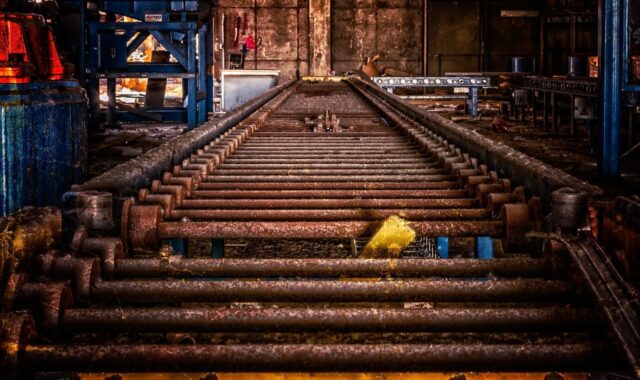
Transport equipment moves materials between locations. In factories and warehouses, this may include forklifts, pallet trucks, tugger carts, conveyors, monorails, overhead cranes, hoists, automated guided vehicles, autonomous mobile robots and transfer cars. The right choice depends on route stability, load weight, throughput, flexibility and facility constraints.
Conveyors work well when routes are stable and flow is frequent. Industrial trucks and tuggers provide flexibility when routes change or volumes fluctuate. Cranes and hoists are often suitable for heavy, awkward or oversized loads where floor travel would be inefficient or unsafe. Mobile robots can add flexible automation, but only when the surrounding process, traffic rules, charging strategy and exception handling are clearly defined.
Storage, buffers and unit loads
Storage is part of MHS because material often waits between steps. Racks, shelving, flow lanes, automated storage and retrieval systems, floor staging, work-in-process carts and returnable containers all influence flow. Poor storage design can create hidden labor when employees must search, reorient, relabel or rehandle material before it can move.
Unit load planning is just as important. A unit load may be a pallet, tote, bin, cart, coil, bundle or custom fixture. The goal is not always to maximize load size. Smaller, more frequent loads can reduce WIP and improve responsiveness, while larger loads may reduce trips in high-volume replenishment. The right answer depends on demand pattern, handling equipment, ergonomic limits and the need for product selectivity.
Controls, sensors and software
Modern material handling systems rely on controls as much as mechanics. Sensors confirm position, presence, weight, dimension, identity or safety status. Controllers, drives, programmable logic controllers and industrial networks coordinate movement. Software may connect the system with warehouse management, manufacturing execution or enterprise planning systems.
Control design should answer practical questions: when should a load be released, where should it go, what happens if the destination is full, how are exceptions reported, and who has authority to clear faults? Without these rules, automation can become a fast way to create disorder.
Safety and compliance boundaries to consider
Material handling creates exposure to struck-by, caught-between, fall, lifting, crushing, stored-energy and ergonomic hazards. In the United States, OSHA 29 CFR 1910 Subpart N addresses materials handling and storage topics including powered industrial trucks, overhead and gantry cranes, crawler, locomotive and truck cranes, slings and related requirements. For powered industrial trucks, OSHA 1910.178 includes training and evaluation requirements, workplace-related operating topics, load stability, rated capacity and safe travel practices.
Conveyor systems also need a standards-based approach. ASME B20.1-2024 applies to the design, construction, installation, maintenance, inspection and operation of conveyors and conveying systems in relation to hazards. The standard covers bulk material, package and unit-handling conveyors, while excluding conveyors designed primarily to move people.
Safety is not an abstract concern. The U.S. Bureau of Labor Statistics reported a 2024 nonfatal injury and illness incidence rate of 4.8 cases per 100 full-time workers for warehousing and storage, compared with 2.7 for manufacturing overall. These figures do not prove that one specific MHS design is safer than another, but they show why warehouse and material-flow environments need disciplined risk assessment.
A practical safety review should include aisle separation, pedestrian crossings, blind corners, load stability, guarding, emergency stops, lockout and energy control, dock operations, battery charging or fueling, rack condition, maintenance access and operator training. For automated systems, it should also address scanner zones, reset procedures, traffic interaction, cybersecurity of controls and how people safely recover from jams or misrouted loads.
Automation trends and implementation risks in 2026
Automation remains a major theme in MHS investment. The 2026 MHI Annual Industry Report, developed with Deloitte and based on a late-2025 survey of supply chain professionals, identified robotics and automation as a highly disruptive supply chain technology area. MHI Solutions summarized report findings showing that 73% of surveyed organizations expected robotics and automation adoption within five years, while also noting common barriers such as capital cost, workforce constraints, integration complexity and long deployment timelines. See also: automation and controls.
For plant managers and operations teams, the lesson is not that every facility should automate immediately. The better conclusion is that MHS automation should be treated as an operating-system change, not a machine purchase. A robot, sorter or AS/RS changes labor roles, maintenance skills, software dependencies, process timing and recovery procedures.
The most reliable automation candidates share several traits:
- Repeatable movement patterns with enough volume to justify the investment.
- Clear load definitions, such as stable totes, pallets or containers.
- Limited exception frequency, or well-designed processes for exceptions.
- Accurate master data for dimensions, weights, locations and inventory identity.
- Maintenance support and spare-parts planning from the beginning.
- Measurable performance targets, such as labor hours per unit, travel distance, accuracy, throughput or downtime reduction.
By contrast, automation becomes risky when the process is still unstable, SKUs are poorly defined, layouts are likely to change, or management expects technology to compensate for weak inventory discipline. In those cases, standard work, slotting, containerization, visual management and basic controls may deliver better first-stage results than high-capital automation.
A selection framework for plants and warehouses
A useful MHS selection process begins with material flow analysis. Teams should document what moves, how often it moves, how heavy and fragile it is, where it waits, who touches it, what information must travel with it and which constraints cannot change. The analysis should cover normal demand, peak demand and exception conditions.
The next step is to compare alternatives based on total system impact rather than purchase price alone. A lower-cost manual approach may be appropriate for low-volume, high-variety operations. A conveyor or automated storage system may be justified where movement is predictable and labor, space or accuracy constraints are severe. A hybrid design often works best, with automation for repeatable backbone movement and flexible manual or mobile equipment for exceptions.
| Operating condition | Likely MHS direction | Reason |
|---|---|---|
| High volume, fixed route | Conveyor, sorter or fixed automation | Predictable flow can justify dedicated equipment |
| Variable routes and mixed SKUs | Tuggers, carts, forklifts or mobile robots | Flexibility matters more than maximum fixed speed |
| Heavy or awkward loads | Cranes, hoists, manipulators or custom fixtures | Load control and ergonomics are central |
| Dense storage with controlled retrieval | AS/RS, vertical lift modules or flow storage | Space and inventory accuracy drive value |
| Frequent line-side replenishment | Kitting, supermarkets and tugger routes | Small, reliable deliveries reduce line disruption |
Financial review should include equipment, installation, controls, software, floor preparation, guarding, training, downtime during changeover, maintenance, energy, spare parts and future modification cost. Operational review should include throughput, safety exposure, inventory accuracy, labor redeployment, serviceability and resilience when a component fails.
Common design mistakes to avoid
The first mistake is optimizing one department at the expense of the full flow. Maximizing storage density, for example, can increase picking time, congestion and replenishment complexity. The second mistake is underestimating data quality. Automation depends on reliable item dimensions, weights, location rules and inventory status. The third mistake is ignoring maintenance access until after installation, when guards, platforms, sensors and drives may already be difficult to reach.
Another common problem is treating safety as a final approval step. Safer MHS design starts early, with layout, visibility, load height, pedestrian separation, control reliability and emergency recovery built into the concept. Retrofitting safety after installation often costs more and may reduce the system capacity that the project was supposed to create.
Finally, teams should avoid relying on a single metric such as maximum hourly throughput. A system that reaches a high peak rate but struggles during changeovers, mixed orders or maintenance windows may perform poorly in real operations. Better scorecards combine throughput, uptime, labor hours, travel distance, damage rate, near misses, inventory accuracy and recovery time.
Frequently asked questions
What is the difference between MHS and material handling equipment?
Material handling equipment refers to specific assets such as conveyors, forklifts, cranes, racks, robots, hoists or carts. MHS is broader. It includes equipment, layout, controls, software, containers, operating rules, safety measures and the people who interact with the flow.
When should a facility automate material handling?
Automation is most suitable when movement is frequent, repeatable, measurable and constrained by labor, safety, space or accuracy problems. If the process is unstable or data is unreliable, facilities should improve standard work and material-flow discipline before investing in complex automation.
How does MHS affect production line efficiency?
MHS affects whether materials arrive at the right process on time and in the correct quantity. Poor material flow causes waiting, excess WIP, blocked aisles, searching, product damage and emergency expediting. Strong MHS design reduces these losses and makes production schedules more reliable.
What standards should be considered for MHS safety?
Requirements depend on jurisdiction, equipment and application. In the United States, OSHA 29 CFR 1910 Subpart N is a key reference for materials handling and storage, while OSHA 1910.178 covers powered industrial trucks. Conveyor projects commonly consider ASME B20.1. Facilities should verify current legal and consensus-standard requirements for their specific equipment and location.