Interroll pallet flow explained for FIFO warehouse storage
What Interroll pallet flow does
Interroll pallet flow is a dynamic pallet storage concept that uses inclined roller lanes to move pallets by gravity from the loading side to the discharge side. For warehouses that need more structured material flow, the value is not limited to storage density. The system is also used to control pallet movement, improve stock rotation and reduce forklift travel inside storage aisles. Interroll describes its PF 1100 pallet flow system as a gravity-lane solution with a 4 percent incline, magnetic speed control and a Time Plus separator for safer pallet release. In practice, this type of system is most relevant where an operation has repeatable pallet loads, predictable lane assignments and a clear need for FIFO or controlled LIFO storage.
Most project questions are practical: buyers, engineers and warehouse managers need to know whether Interroll pallet flow fits their rack layout, pallet type, throughput target and safety requirements. The answer depends less on the brand name alone and more on lane engineering, pallet quality, rack design, forklift interaction and maintenance discipline.

How gravity pallet flow lanes work
A pallet flow lane is different from a conventional selective rack bay. In a static rack, the forklift places and retrieves pallets directly from each storage position. In a pallet flow rack, pallets are loaded into a sloped lane and travel across rollers or wheel tracks under gravity. In a FIFO lane, the first pallet loaded becomes the first pallet available at the pick face, while the following pallets accumulate behind it.
Interroll product literature describes non-powered rollers and gravity as the basic movement mechanism. This is important because the storage lane does not need a motorized drive for every pallet movement. Even so, a gravity lane still needs engineered control. Pallets vary in weight, underside condition, board direction, load stability and friction. Without control devices, a heavy or low-friction load can move too quickly, while a damaged pallet can jam or skew in the lane.
Interroll’s pallet flow concept typically relies on three functional groups:
| Element | Role in the lane | Why it matters |
|---|---|---|
| Rollers or roller tracks | Support the pallet and allow gravity movement | They must match pallet underside, lane depth and load weight |
| Magnetic speed controller | Limits pallet speed as it travels down the lane | It reduces impact risk at the discharge end and helps protect goods |
| Time Plus or driven separator | Holds back the following pallet while the front pallet is removed | It creates safer spacing and prevents the next pallet from immediately pressing into the pickup position |
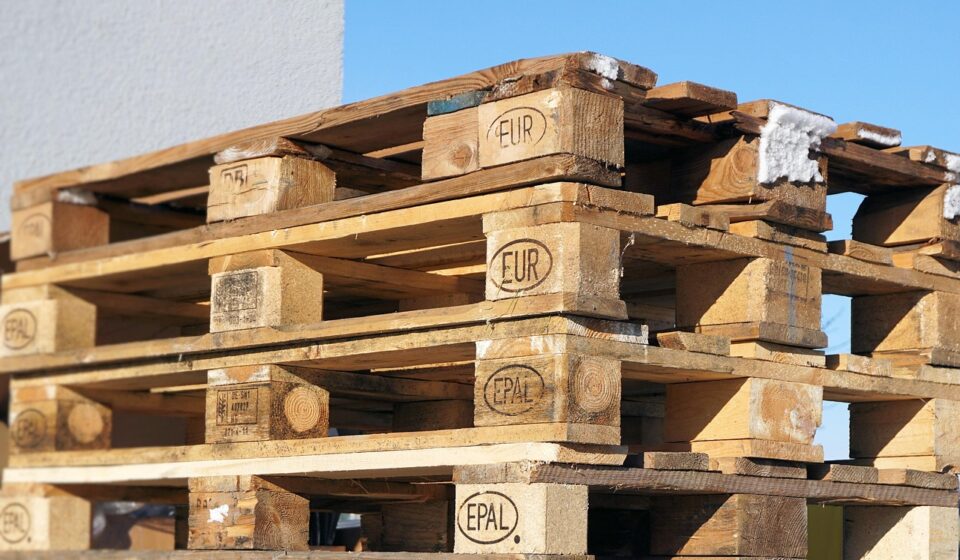
Interroll states that the PF 1100 supports pallet loads from 60 to 1,250 kg, depending on configuration and application. Its newer public product materials also identify FIFO and LIFO options for EUR EPAL pallet dimensions of 800 x 1200 mm and 1000 x 1200 mm, with LIFO support for UK CHEP 1000 x 1200 mm pallets. These figures are useful as an initial reference point, but they should not replace project-specific validation. A real installation still requires pallet testing, rack engineering and a review of the handling equipment used at loading and unloading.
FIFO, LIFO and the real storage decision
FIFO means first in, first out. In a typical pallet flow rack, pallets are loaded from one aisle and unloaded from the opposite aisle. This is why pallet flow is often considered for food, beverage, consumer goods, cold storage and other inventory where rotation discipline matters. MHI’s educational material describes pallet flow as a gravity-based rack format in which back-loaded pallets flow toward the front or pick face, and it associates pallet flow and carton flow with FIFO inventory systems.
LIFO means last in, first out. In a LIFO pallet flow or push-back-style arrangement, pallets are loaded and retrieved from the same side. The newest pallet is usually the first one removed. Interroll states that its pallet flow family can support both FIFO and LIFO applications, but the layout decision affects aisle planning, forklift travel, product rotation and inventory control.
The simplest way to compare the two is to start with product behavior:
- Use FIFO when lot control, expiry dates, production sequence or customer requirements make rotation essential.
- Use LIFO when each lane holds a homogeneous SKU, rotation is less critical and the operation wants high density with single-aisle access.
- Use selective rack when SKU variety is high, lane quantities are low or direct access to every pallet is more important than density.
- Use automation integration when pallet movement must connect to conveyors, AGVs, stacker cranes or WMS-directed release logic.
For Interroll pallet flow, the key point is that the same broad technology category can serve different inventory strategies. The storage policy should be selected before the lane hardware, not after it.
Design checks before specifying Interroll pallet flow
Dynamic pallet storage is sensitive to details that may seem minor in a normal rack layout. A pallet with broken bottom boards, protruding nails, inconsistent moisture content or warped stringers can behave unpredictably on rollers. A load that overhangs the pallet can interfere with uprights or neighboring lanes. A forklift operator who approaches at the wrong angle can damage lane components or rack frames.
Interroll’s application data sheets ask for pallet dimensions, load weight, pallet type, load size, secured-load status, temperature range, lane count, lane length, slope, brake selection and separator choice. That information is not just paperwork. It is the basis for deciding whether the lane can reliably convey the pallet.
| Planning question | What to verify | Risk if ignored |
|---|---|---|
| Pallet construction | Bottom board direction, deck condition, pallet material and contact surface | Jams, skewing, uneven travel or roller damage |
| Load range | Minimum and maximum pallet weight, including pallet weight | Light pallets may not flow; heavy pallets may travel too aggressively |
| Lane depth | Number of pallet positions, separator allowance and rack depth | Reduced usable capacity or unsafe pallet spacing |
| Environment | Ambient, chilled, freezer, dust, humidity and cleaning conditions | Changed friction, bearing performance or corrosion exposure |
| Forklift interface | Lift-off height, approach path, pallet stop position and operator visibility | Rack impact, poor pickup ergonomics or blocked discharge positions |
| Controls | Manual release, mechanical separator, driven separator, WMS or PLC interface | Mismatch between storage lane and dispatch process |
Project teams should treat pallet flow as a three-part system: the flow components, the rack structure and the operating method. A strong component specification cannot compensate for poor pallet condition. A well-designed rack cannot overcome a lane assigned to too many low-volume SKUs. A WMS rule cannot fix a discharge end that is physically difficult for operators to access.
Safety, standards and operational discipline
Pallet flow lanes store heavy moving loads above and near forklift traffic, so safety planning must go beyond capacity claims. Interroll emphasizes speed control and pallet separation as safety features. Its magnetic speed controller literature states that pallet speed can be kept below 0.3 m/s in suitable applications, while separator mechanisms are intended to hold back the following pallet until the leading pallet has been removed. A driven separator can add software-adjustable release timing and integration with external controls where the application justifies it. See also: automation and controls.
Rack safety also belongs in the discussion. The Rack Manufacturers Institute identifies ANSI MH16.1-2023 as a design, testing and utilization standard for industrial storage racks. OSHA warehouse guidance also reminds operators not to exceed storage rack load capacities and to maintain material-handling equipment. These sources do not turn every pallet flow decision into a legal checklist, but they make the responsibility clear: the rack, the flow lanes and the operating process must be designed, installed, inspected and used as a system.
Practical safety checks should include visible load capacity signage, rack anchoring review, upright protection in forklift impact zones, routine inspection of rollers and separators, removal of damaged pallets from the system, and clear procedures for blocked pallets. Operators should not improvise a rescue method for a stuck pallet inside a deep lane. The safer approach is to close the lane, isolate the hazard and follow the supplier’s documented procedure or a qualified engineer’s instruction.
Where Interroll pallet flow adds value and where it may not
Interroll pallet flow is strongest where the warehouse has repeatable pallet types, medium-to-high volume SKU lanes and a reason to reduce travel inside storage areas. Common use cases include production buffers, cold-chain storage, beverage distribution, dispatch staging, pick tunnels and dense reserve storage. In these environments, gravity flow can reduce forklift travel because pallets advance to the pick face instead of requiring the truck to enter each storage position.
The system may be less attractive where the SKU profile is highly fragmented, pallet quality is inconsistent, loads are unstable, or the operation needs immediate access to every pallet. Very low turnover SKUs can leave deep lanes underused. Mixed pallet sizes in the same lane require additional engineering attention, and some operations may need a driven separator or automated interface rather than a purely mechanical release concept.
Cost evaluation should therefore include more than rack price. The decision should consider recovered floor space, aisle reduction, forklift travel distance, product damage risk, labor at the pick face, cold-room energy exposure and the value of rotation accuracy. A high-density lane that is frequently blocked, mis-slotted or loaded with poor pallets will not deliver the intended material-flow benefit.
Frequently asked questions
Is Interroll pallet flow only for FIFO storage?
No. Interroll describes its pallet flow family as suitable for both FIFO and LIFO applications, depending on pallet type and layout. FIFO usually loads and unloads from opposite sides, while LIFO typically works from one side. The right choice depends on stock rotation rules, aisle strategy and SKU behavior.
Does a gravity pallet flow lane need power?
The basic pallet movement in a gravity lane does not require a motor drive, because the pallet moves down an inclined roller path. Some applications may add powered or software-controlled devices, such as a driven separator, when precise release timing or automation integration is required.
What pallets work best in pallet flow systems?
Pallets with consistent dimensions, sound bottom boards and predictable contact surfaces work best. Broken boards, exposed nails, warped runners, unstable loads and large overhangs can create travel problems. For that reason, pallet testing and inspection procedures are important before and after installation.
Can Interroll pallet flow be added to any rack?
Interroll states that PF 1100 is compatible with common racking, but compatibility does not mean every existing rack is automatically suitable. The rack must be checked for load capacity, depth, beam spacing, anchoring, impact exposure and the required lane components. A qualified rack professional should review retrofit projects.
What is the main limitation of pallet flow?
The main limitation is reduced flexibility compared with selective rack. Pallet flow performs best when each lane has enough volume of the same or compatible SKU to justify deep storage. If the product mix changes constantly or every pallet requires direct access, a different storage strategy may be more efficient.